“ You Will Write History.”
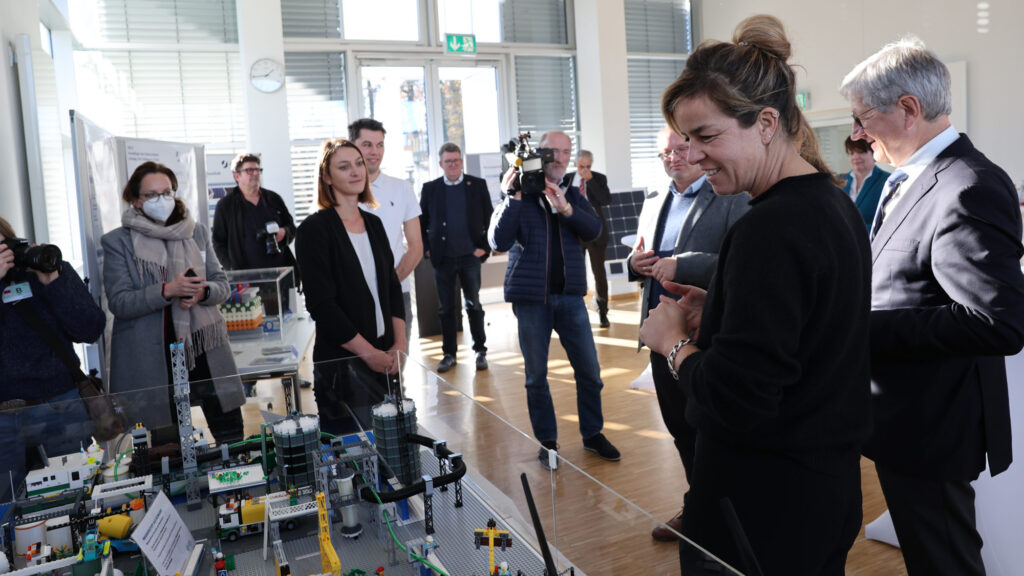
Mona Neubaur, Minister of Economics of North Rhine-Westphalia (NRW), visited Forschungszentrum Jülich on Monday to find out about the centre’s contribution to structural change in the Rhenish mining area and its innovative approaches for a sustainable and secure energy system of the future. The focus was on hydrogen as a key element for a successful energy transition and new photovoltaic technologies.
The NRW state government has set itself the task of transforming NRW into Europe’s first climate-neutral industrial region and phasing out lignite mining and lignite-based electricity generation by 2030. Scientific innovations are essential for a successful transformation.
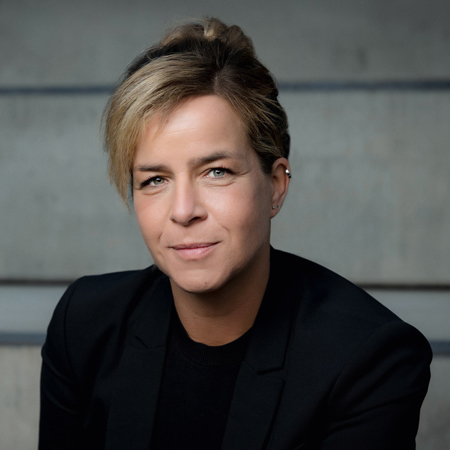
“Climate protection and net-zero technologies will form the basis for the Rhenish mining area of tomorrow. I’m delighted that Forschungszentrum Jülich, as a strong and active partner, is helping to shape structural change in the region and create new jobs in collaboration with business and industry. Jülich’s research quality, particularly in the fields of energy and climate change, is outstanding – by international standards as well. Future technologies such as hydrogen, power-to-x, and photovoltaics are successfully being transferred from research into application here in North Rhine-Westphalia.”
Mona Neubaur, Minister for Economic Affairs, Industry, Climate Action and Energy of North Rhine-Westphalia
After a welcome address by Prof. Wolfgang Marquardt, Chair of the Board of Directors of Forschungszentrum Jülich, and Dr. Stephanie Bauer, head of Project Management Jülich, Prof. Peter Wasserscheid from the Institute for a Sustainable Hydrogen Economy spoke about the progress in creating the HC-H2 Helmholtz cluster. The cluster aims to demonstrate the role that hydrogen could play in the energy system of the future, i.e. that of an essential energy carrier as common as petrol or diesel and as a raw material for many industrial products that will enable the coupling of energy supply and production. The project is also expected to help create new jobs in the Rhenish mining area.
“You will write history,” said the Minister after Peter Wasserscheid explained the goals of HC-H2 using a LEGO model.
Director Prof. Rüdiger Eichel and Dr. Lucy Dittrich from the Institute of Energy and Climate Research – Fundamental Electrochemistry explained how the “climate killer” CO2 can in future be used as a sustainable raw material for the chemical industry. Scientists from Jülich and RWTH Aachen University are developing new technologies for this as part of the structural change project iNEW.
Innovative photovoltaic technologies have the potential to make a large contribution to NRW’s net-zero electricity supply, explained Prof. Uwe Rau from the Institute of Energy and Climate Research – Photovoltaics (IEK-5). Integrated photovoltaics (IPV) are highly promising in this context. Applications range from floating solar plants and solar modules elevated above agricultural land to solar cells integrated in building façades, roofing tiles, and vehicle bodies.
The copyright for the images used on this website is held by Forschungszentrum Jülich, aligator kommunikation GmbH and
stock.adobe.com.